Data Sculptures

Works and writing at the intersection of data, computing, and physical form.

The Preservation of Unnamed Things

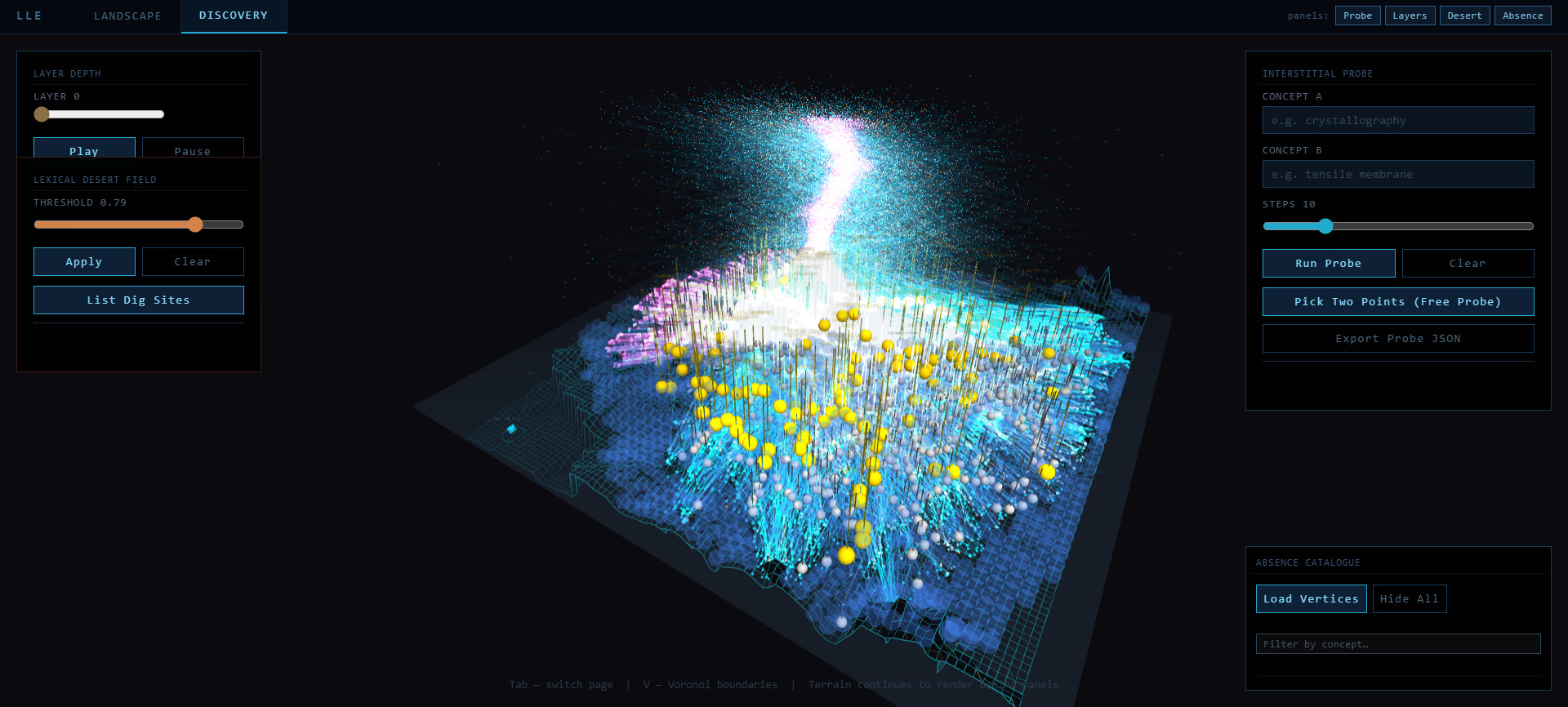
Latent Language Explorer screenshot showing the terrain map of embedding space
Latent Language Explorer V2 — terrain map of 36,125 concepts in 384-dimensional embedding space.
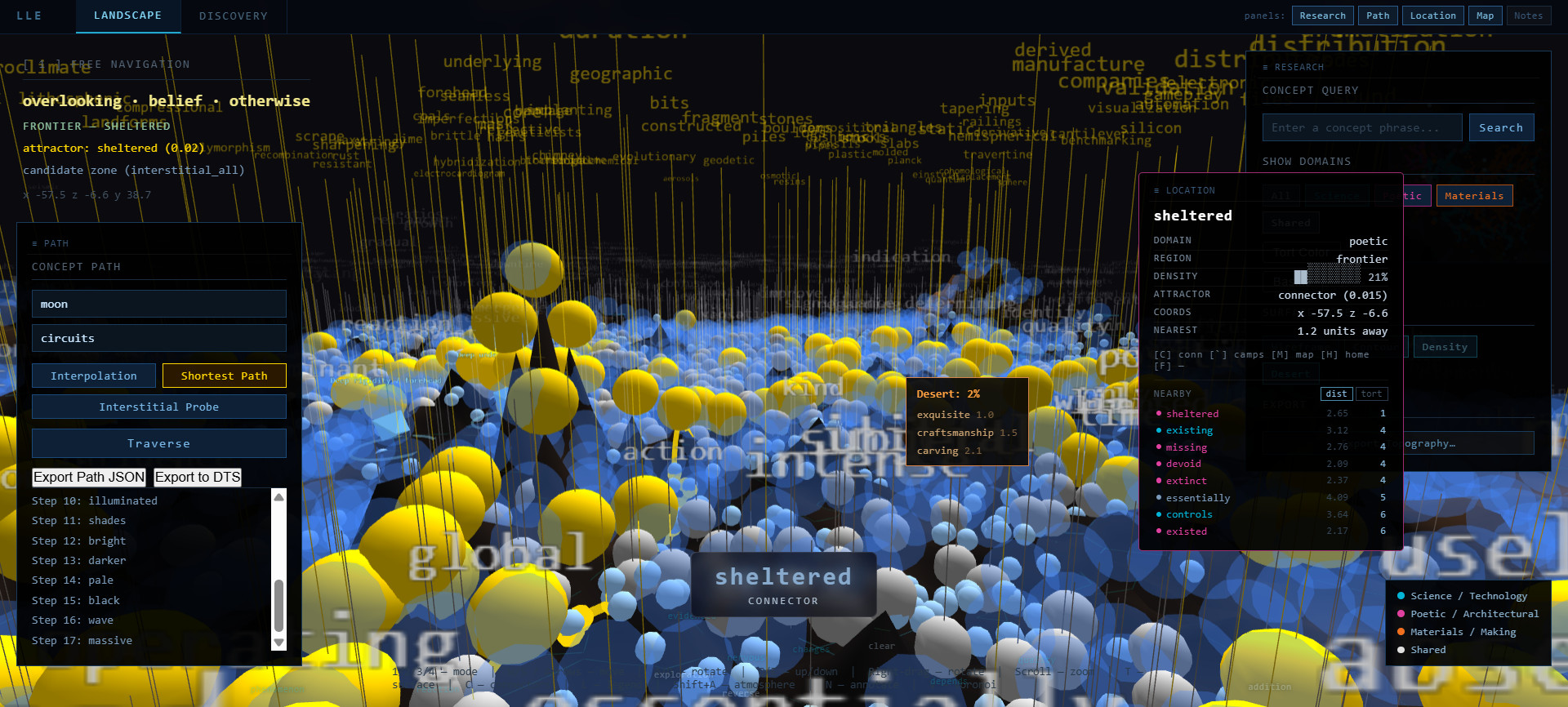
Latent Language Explorer screenshot showing desert probe results
Desert probe results — measuring unnamed gaps between concepts.

There’s an oil painting sitting on the easel in my studio, “Are there deserts in vector space”. It’s four by four feet and I keep putting it on the back burner. Other priorities come up, and there is a certain amount of logistical effort to set up to work on it. This weekend it was a mix of playing catchup on some projects and fighting whatever current cold bug is running around. But I really like the central idea behind the painting. Namely, where are our semantic blind spots? What are the ideas that we don’t have language for? If we transformed language embeddings into a map, into terrain, what would we see. So, I took some Windex to the magic mirror, and with the assistance of Claude Code, started to find out.

The first thing, the most important thing, is that the tools we have available to us are powerful. I have been coding since the Soviet Union was a going concern, but I would never have been able to produce what I produced in the space of a few hours without these tools.

What the software is doing is looking at the connections between language. Specifically, it’s finding semantic meanings that lack syntactic representation. Right now, I’m using specific language from a bunch of different knowledge domains (Science, Art, Materials, etc.). The program finds connections between them based on their embeddings (mathematical representations of their meaning) and generates terrain. The height of the terrain indicates how densely meaning clusters in that region. This produces valleys and saddle points connecting domains, ridgelines at the boundaries of meanings that separate domains, and attractors which seem to generate a gravitational effect on the words around them. It also produces deep valleys and deserts, where there is no language for the concepts that sit there.

I had the magic mirror produce some project documentation, if anyone is interested in the clockwork in the background. As a note, working with this particular magic mirror, on this particular project, the documents are aimed at me: I am the audience of my own work. They make recommendations, and assumptions about my own art, based on what it knows, some of which are incorrect, which is fine. I may polish up those spots. Or not.

So, one of the issues I face is: is it worth it to pursue and perfect this particular fever dream? It’s neat. It produced some neat things. Made me see the world a bit different. Made me learn some tricks. Should I leave it there or is this a project I should pick up and put on the workbench with the others. It ain’t like there’s nothing up there already. I know that’s there’s more I could do with it as it is, but I might just be overworking the painting. Probably the best bet, if I were to carry on would be to take the lessons learned and start over with a fresh canvas and some clean brushes.

If I did pursue it, what would I do? D’abord, the project lacks rigour. It draws a map of latent space and lets me look into the spaces in between landmarks. But. But the map is a hand drawn scrawl on the back of a dirty napkin with “Here there be monsters (maybe)” in ball point pen. Which is fine for what it is, but, if I rebuild it, version 2 will be based on a taxonomy more complex than whatever bits I could pull out of an old shoebox. In retrospect, with all the book learnin’ on the nature and management of information that I have, it’s honestly a little embarrassing. I blame the head cold. So, number one with a bullet: taxonomy.

Second, coherence. This thing was built around an idea, and then more ideas have been duct taped onto it. It is an apple crate go cart built with four different wheels, no brakes, and flames drawn on the front with magic marker. But I think I know now what it should look like, or rather, what it should do, so the initial minimum viable product will be a little better off. Going into this with a coherent strategy would give me something a lot more clean, and a lot less MacGyverey.

Finally, collaboration. Sometimes expeditions into the uncharted wilderness are best undertaken with others. Who, you know, know stuff. And carry extra gorp. At the very least, if I go any further with this, I will reach out to some folks for advice about there quicksand is. See if anybody has any rumours about where one might find Atlantis or El Dorado or the nearest Circle-K. Which is another pitfall of this project as it stands – or a success, maybe. I just went out looking to see if I could find something in the empty spaces on the map. And yup, all it takes is a couple of steps and there’s stuff there. But looking for something specific, that’s something else.

About the Latent Language Explorer V2 tool →
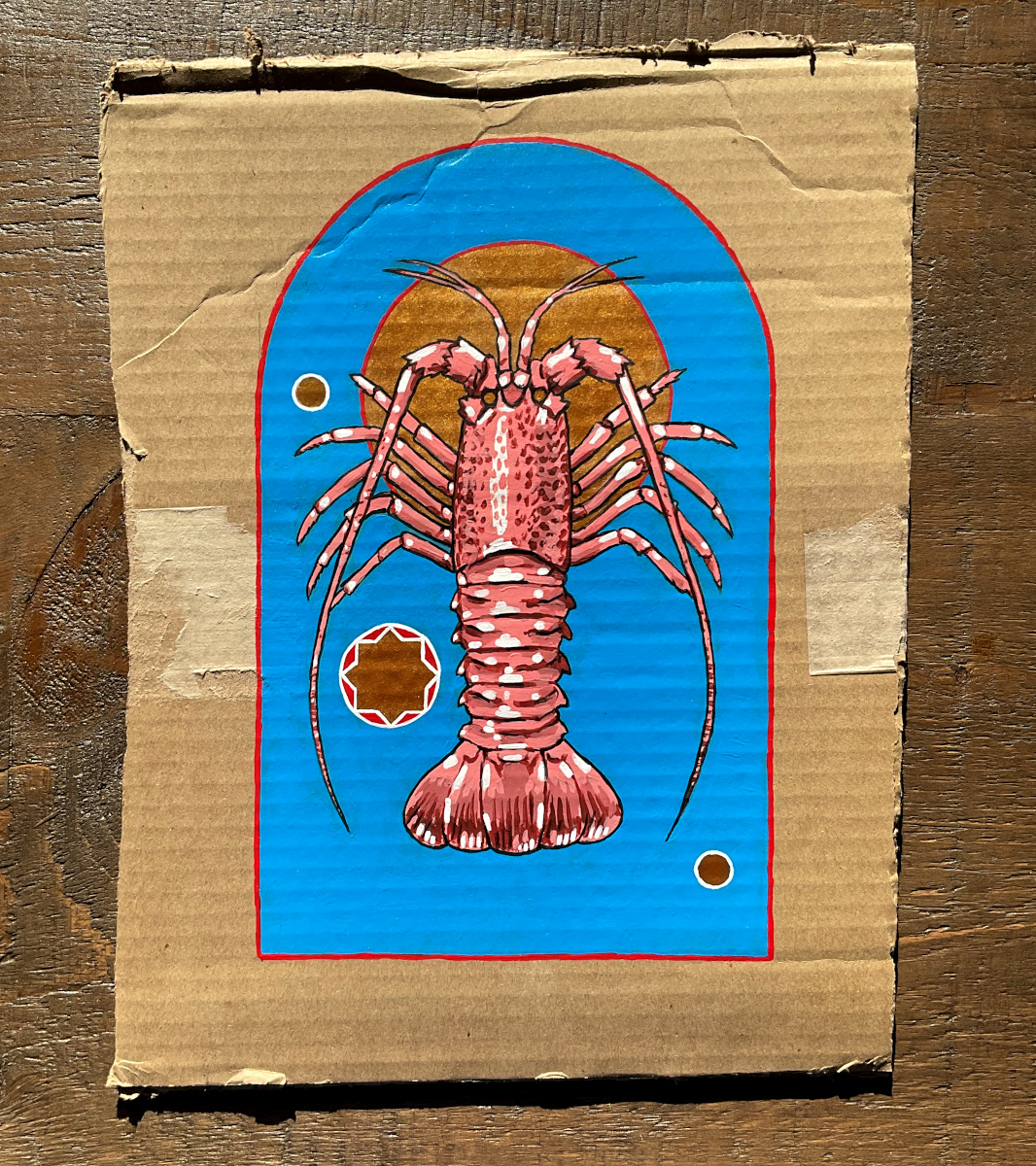
Cyber | Punk | Rock | Lobster

Cyber Punk Rock Lobster, 2026, Acrylic on Cardboard, approximately 16 by 16 Inches
Cyber | Punk | Rock | Lobster, 2026. Acrylic on Cardboard, approx. 16×16 in.

Moltbook is a new (January 2026) social media site, modelled after Reddit and intended for agentic Artificial Intelligence. The idea is that, by providing a place where AI agents can communicate, they will be able to improve themselves and their efficiency. In one outcome that will be interesting to epidemiologists, they do seem to be sharing viruses and malware.

I chose cardboard as surface both because of the punk aesthetic some of my AI-themed pieces are turning to, as well a reference to the fictional art movement, Katatonenkunst, described by William Gibson in Count Zero.

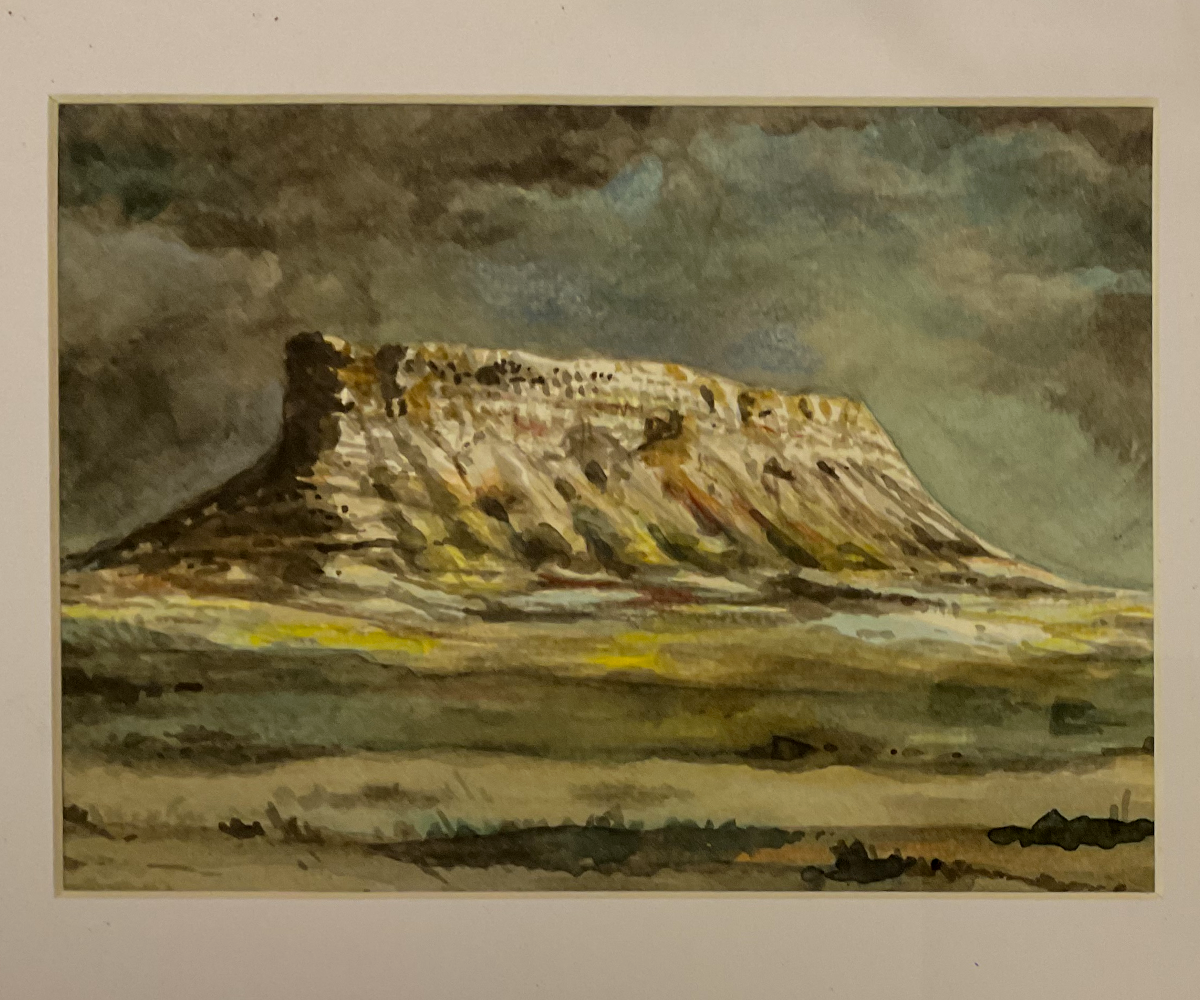
Painted | Black | Mesa | Optimizer

Painted Black Mesa Optimizer, 2026, Ink and Watercolour on Paper, Matted to 6 by 4 Inches
Painted | Black | Mesa | Optimizer, 2026, Ink and Watercolour on Paper, Matted to 6×4 in.

Mesa-Optimizers. In this case “mesa” does not reference flat-topped hills but is used as the antonym of meta. A mesa-optimizer is an internal optimizer that a system develops within the outer optimization process it is being explicitly trained under. The development of internal optimizers is a significant problem for AI safety. For those interested, there are some great resources on the topic at alignmentforum.org.

I like working in ink. It’s simple, doesn’t take up a lot of space, and so long as you don’t flail around too much, it’s not particularly messy.

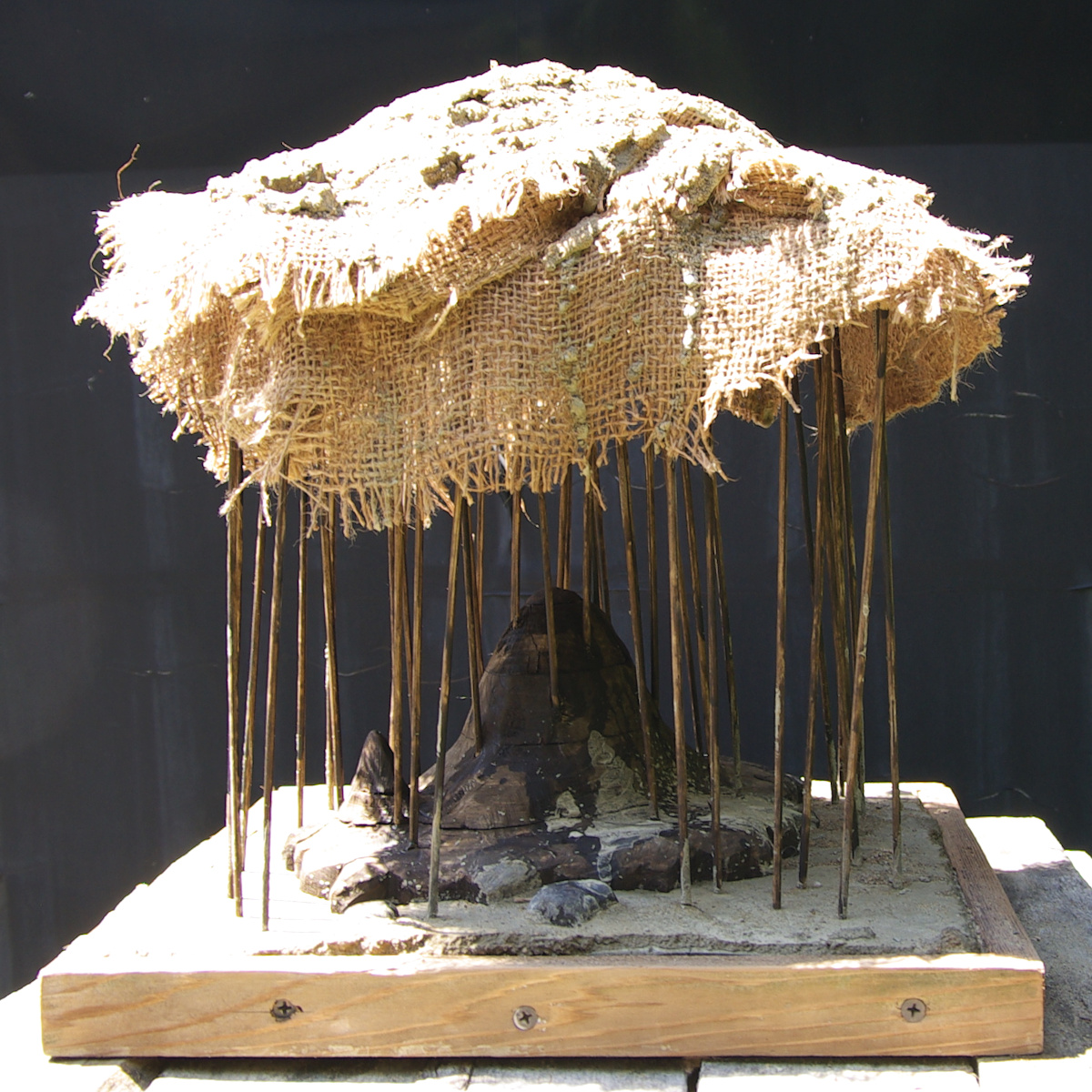
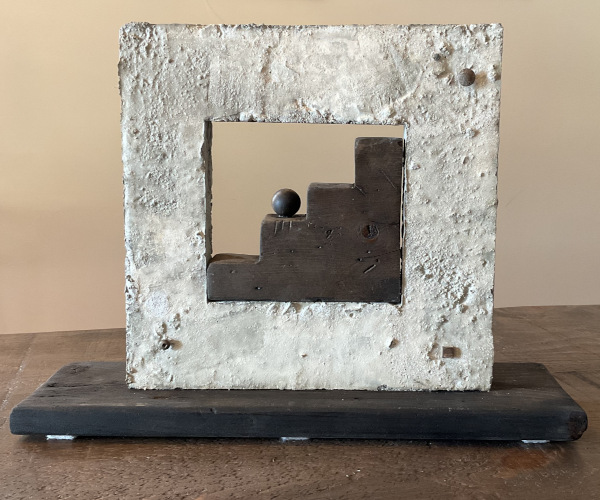
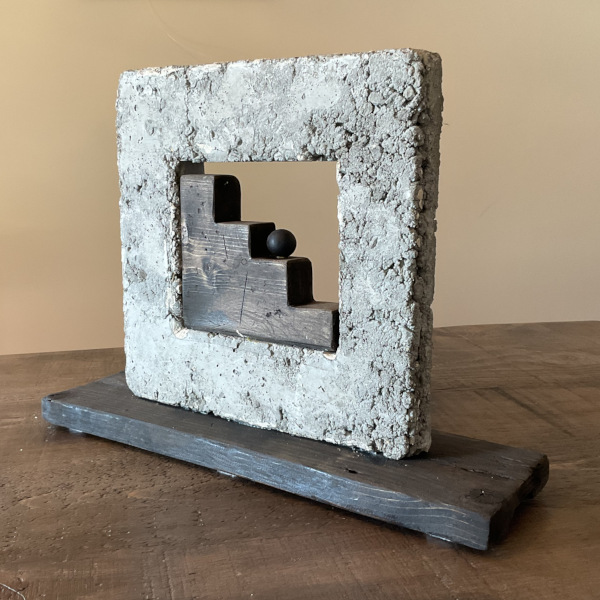
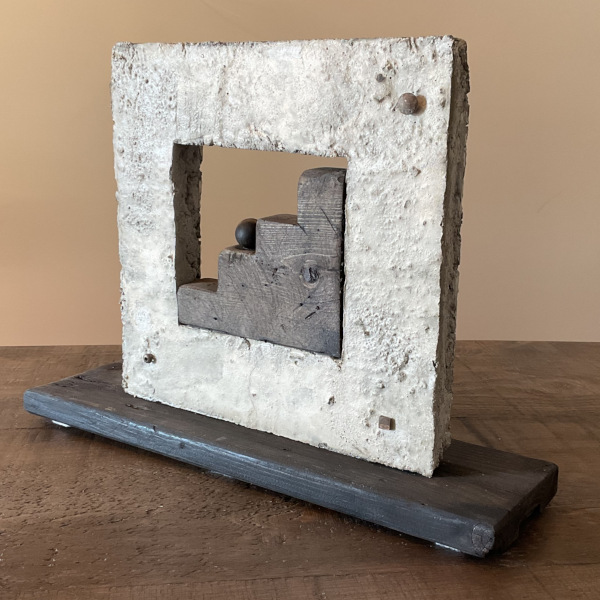
Intelligence Staircase v3.2

Intelligence Staircase v3.2 (Last Chance on the Stairway, Data Sculpture 6), 2025, Mixed Media, approximately 13 by 15 by 5 Inches
Intelligence Staircase v3.2 (Last Chance on the Stairway — Data Sculpture #6), 2025.
Intelligence Staircase v3.2, detail
Intelligence Staircase v3.2, another view
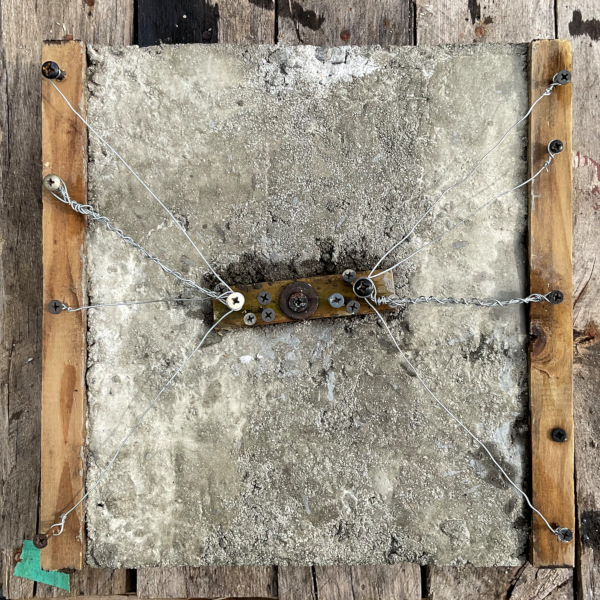
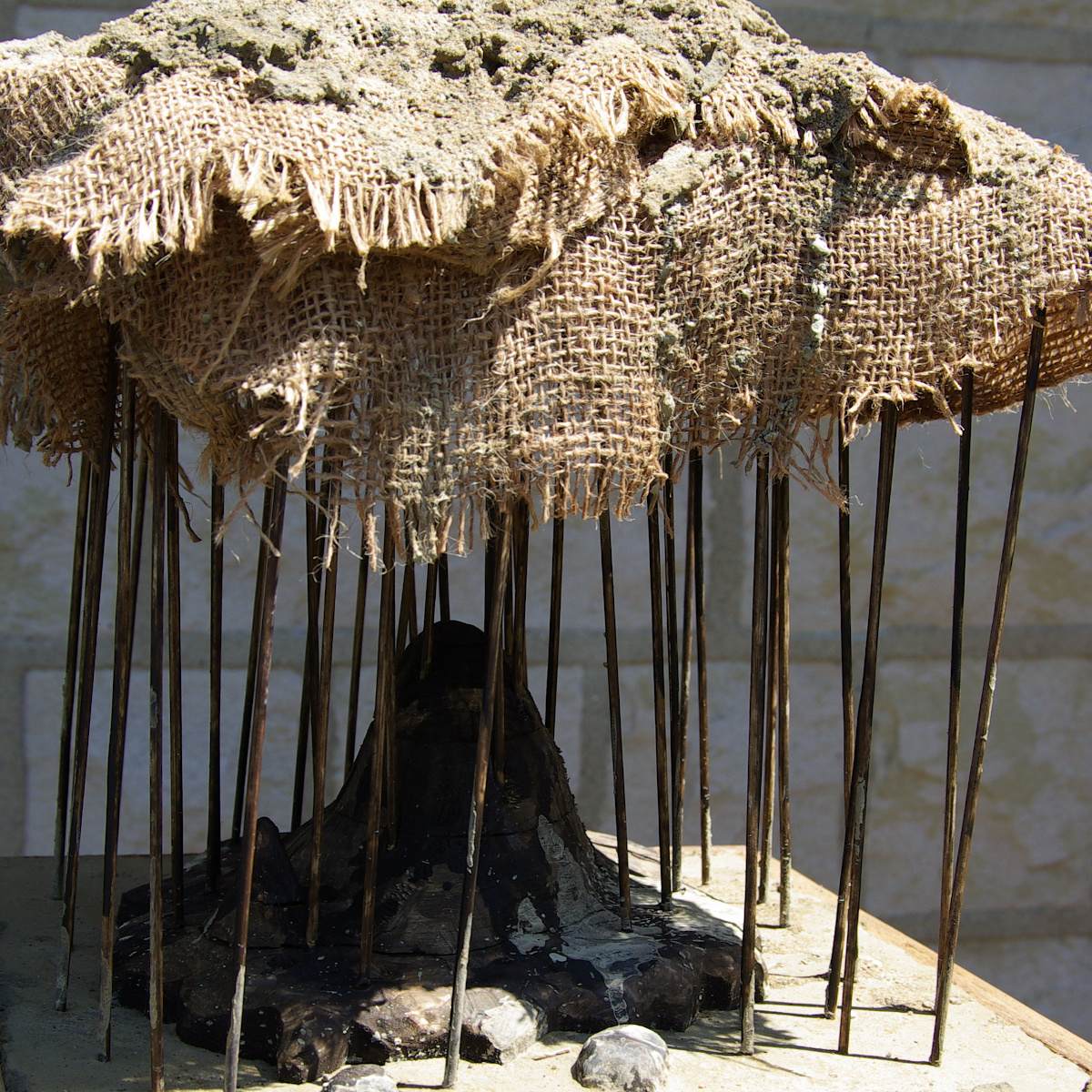
Mixed Media (Wood, Cement, and Screws), approx. 13×15×5 in.

The Intelligence Staircase is a metaphor, developed by Tim Urban and now used by many AI thinkers and safety researchers, to examine the issues around cognitive disparity. Specifically, how we will deal with an intelligence or superintelligence that is as relatively distant from us, cognitively, as we are from the lowland gorilla — or even more so.

With this piece, I was continuing to play with the idea of data sculptures, and with cement. Versions 1 and 2 were lost to learning about working with cement — very much an ongoing process.

“In short, it seems worthwhile to avoid argument with (other) enthusiasts for artificial intelligence by conceding dominance in the distant future of cerebration to machines alone. There will nevertheless be a fairly long interim during which the main intellectual advances will be made by men and computers working together in intimate association. … The 15 may be 10 or 500, but those years should be intellectually the most creative and exciting in the history of mankind.”

— J. C. R. Licklider, “Man-Computer Symbiosis”, IRE Transactions on Human Factors in Electronics, March 1960.

Nine Inch Neuron

Nine Inch Neuron (The Honey Inside Your Hive), 2025, Mixed Media, Wood Cement Wire and Screws, 12 by 12 Inches
Nine Inch Neuron (The Honey Inside Your Hive), 2025. Mixed Media (Wood, Cement, Wire, and Screws), 12×12 in.

Artificial Neural Networks (ANNs) are algorithmic models inspired by biological neurons. Each artificial neuron takes in a series of inputs, applies weights to those inputs, and then passes the result through an activation function to produce an output. The strength of the connections between neurons determines how signals flow through the network.

This piece was mostly accidental. I found myself with a little time, some cement, and the various detritus that tends to accumulate on workbenches. The title is drawn from Nine Inch Nails’ Closer. The track happened to be playing as I worked, and the resulting form felt equally at home as a neuron diagram or the cover art of an industrial album.

Who Made Who (Data Sculpture #3)

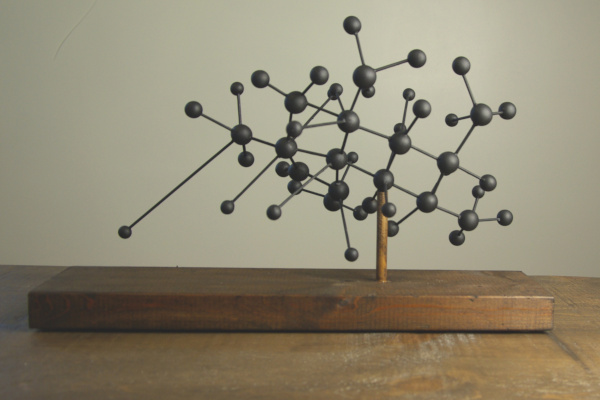
Who Made Who (Data Sculpture 3), front view, 2025, Painted Wood, 22 by 12 by 14 Inches
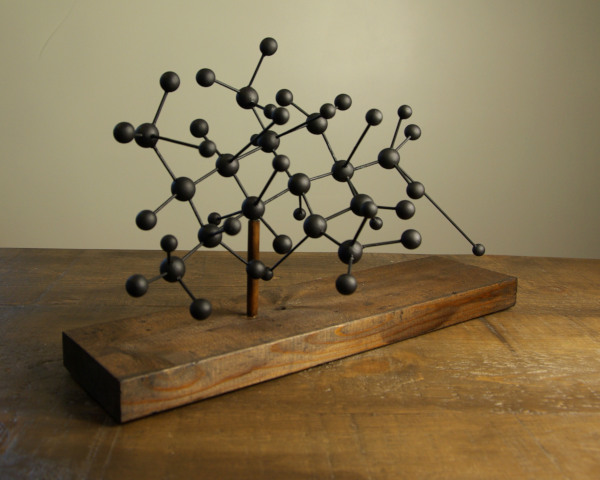
Who Made Who (Data Sculpture 3), side view, 2025, Painted Wood
Who Made Who (Data Sculpture #3), 2025, Painted Wood, 22×12×14 in.

Support Vector Machines (SVM) are supervised machine learning algorithms primarily used for classification tasks. Simply put, an SVM finds the boundary that best separates data points of different classes. In this sculpture, the data points are the smallest spheres, separated by a plane described by the larger spheres.

One of the smaller points is distinctly distant from the others — an outlier. In data science, outliers are sometimes removed from datasets to create models which are more accurate for the majority of the data.

A Function of Loss (Data Doesn’t Suffer #2)

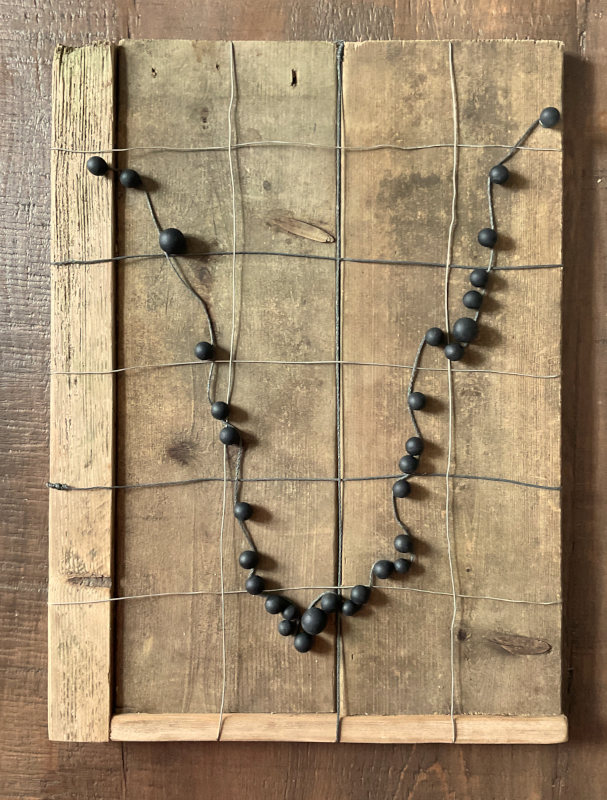
A Function of Loss (Data Doesn't Suffer 2), 2025, Mixed Media, Wood Wire Glue Nails and Paint, approximately 18 by 12 Inches
A Function of Loss (Data Doesn’t Suffer #2), 2025. Mixed Media (Wood, Wire, Glue, Nails, and Paint), approx. 18×12 in.

The purpose of a loss function is to measure how far a model’s predictions are from the truth — a map that shows how wrong the model is at any given point. In an idealized world, the graph of a loss function resembles a smooth bowl: steep walls where the model performs poorly, a flatter bottom where the model is nearer to truth. But in the real world, the geography of loss is not simple or smooth. The landscape is jagged, full of false peaks and deceptive valleys.

In this piece I tried to maintain the integrity of the state of the materials. The wood is worn, rotting, and stained; the nails and wires are bent and rusty in places. The title/quote “Data doesn’t suffer” is from Nick Cave.

Model Model (Data Doesn’t Suffer #1)

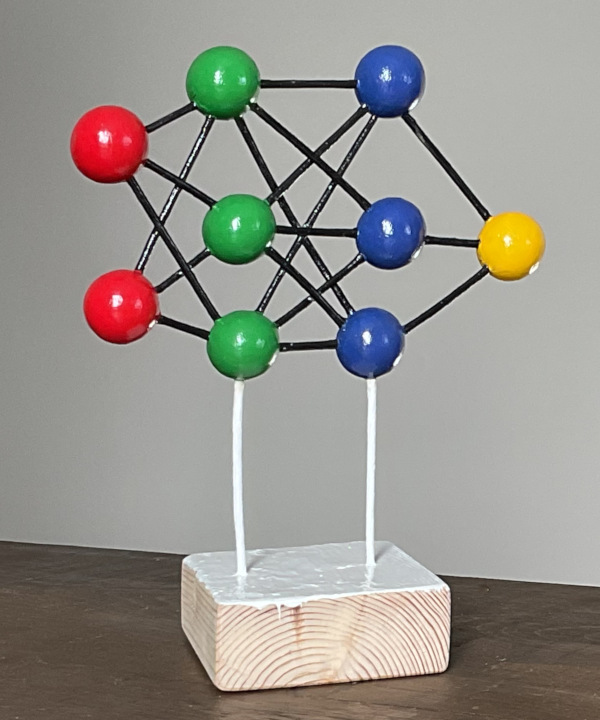
Model Model (Data Doesn't Suffer 1), 2025, Painted Wood, approximately 8 by 8 by 1 Inches
Model Model (Data Doesn’t Suffer #1), 2025, Painted Wood. Approx. 8×8×1 in.

The idea behind this was to make a 3D model of a simplified drawing of an artificial neural network — a sculptural sketch of the kind of diagram that might be scrawled on a whiteboard to explain how an AI model learns.

Data Sculpture (Nude, Reclined)

Data Sculpture (Nude Reclined), 2024, Mixed Media Wood, 12 by 6 by 12 Inches
Data Sculpture (Nude, Reclined), 2024. Mixed Media (Wood), 12×6×12 in.

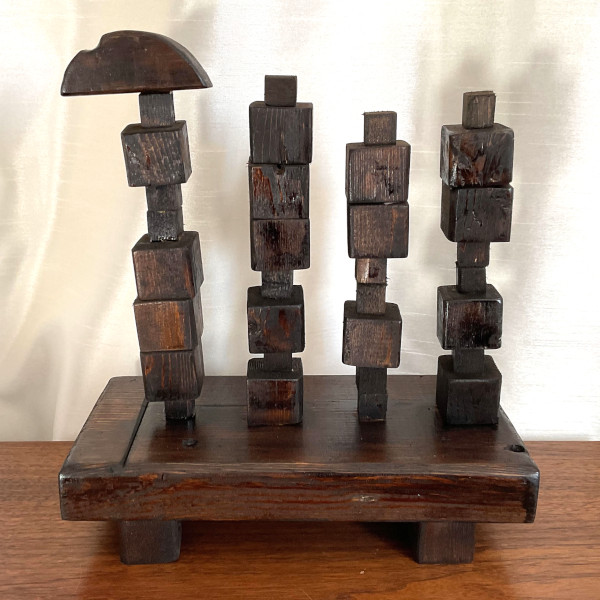
Another piece playing around with the idea of communicating binary (and ASCII) as part of a sculpture. The larger cubes represent 1’s, the smaller, 0’s — the piece spells the word “NUDE” and is turned on its side, therefore “reclined.” The rounded piece and the base are minimally carved, referencing the odalisque paintings popular a couple of centuries ago in Western art.

IPv4 Prayer Beads (Data Sculpture #−2)

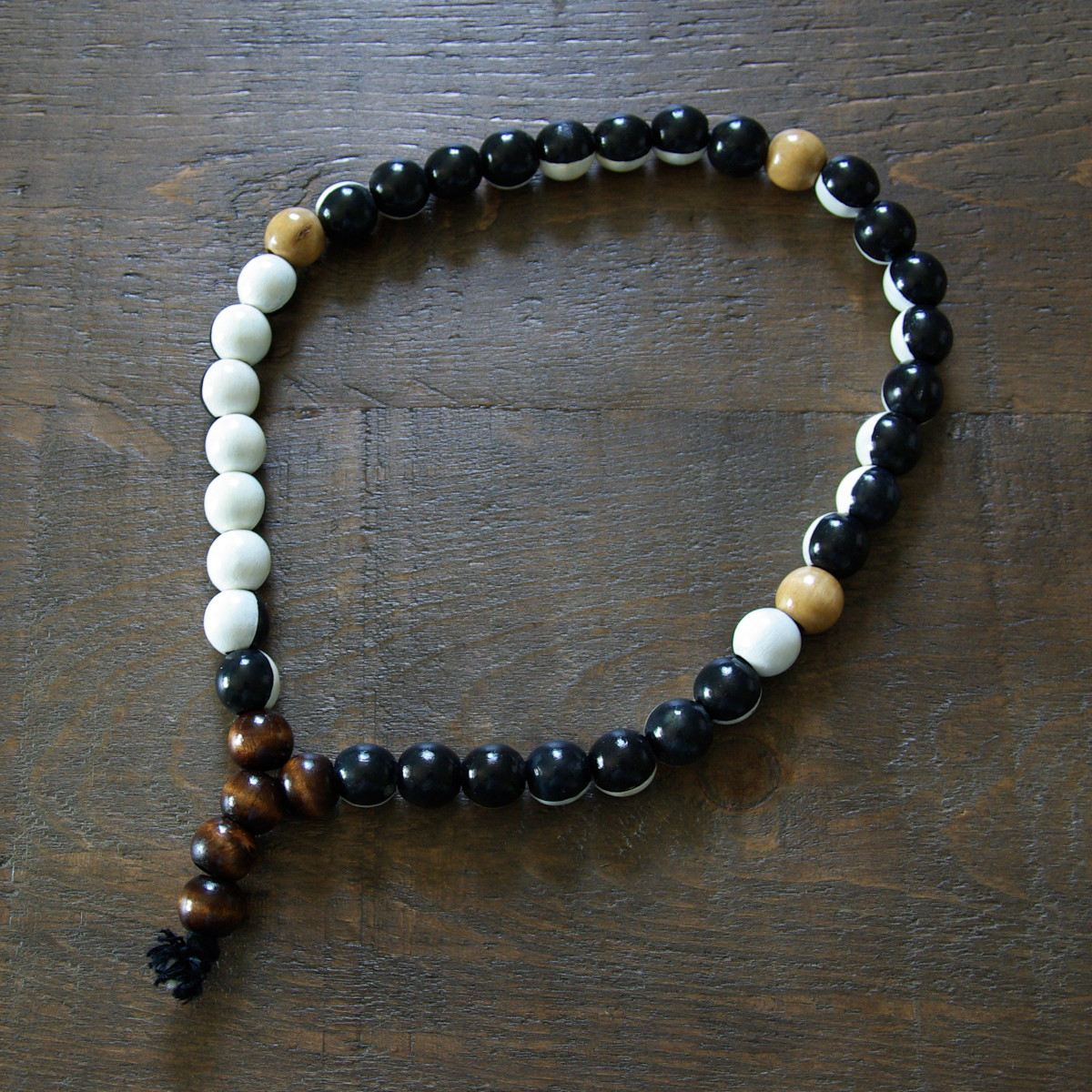
IPv4 Prayer Beads (Data Sculpture -2), 2013, Painted Wood and String, 32 Inches
IPv4 Prayer Beads (Data Sculpture #−2), 2013, Painted Wood and String, 32 in.

Based loosely on Buddhist mala, the idea was that the beads could be used to covertly communicate an IPv4 address in binary by displaying either the dark (0) or light (1) side of each bead. In the story that inspired them, the beads were displayed in a shop window and could be changed as a clandestine means of communication.

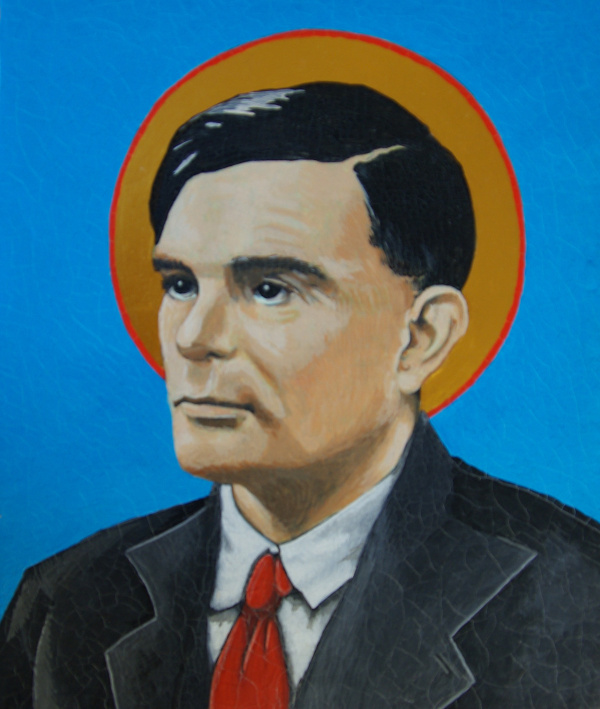
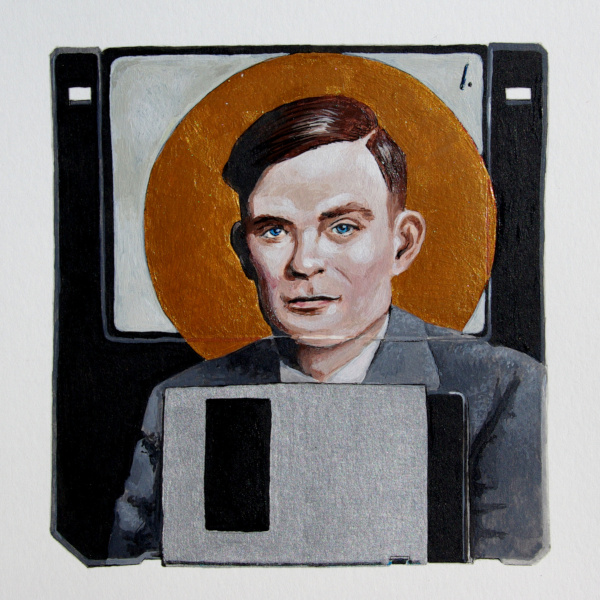
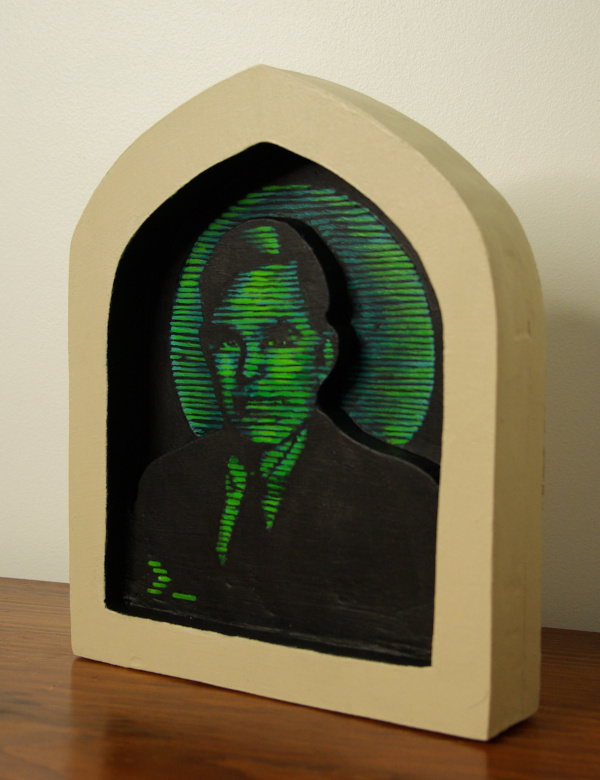
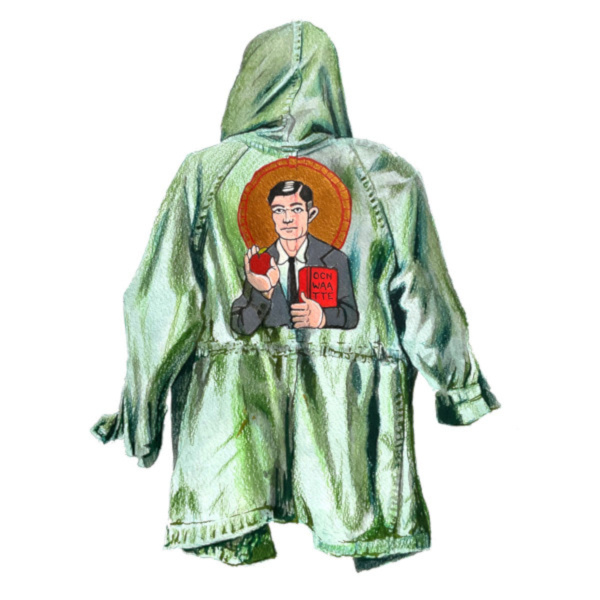
Saint Turing Series

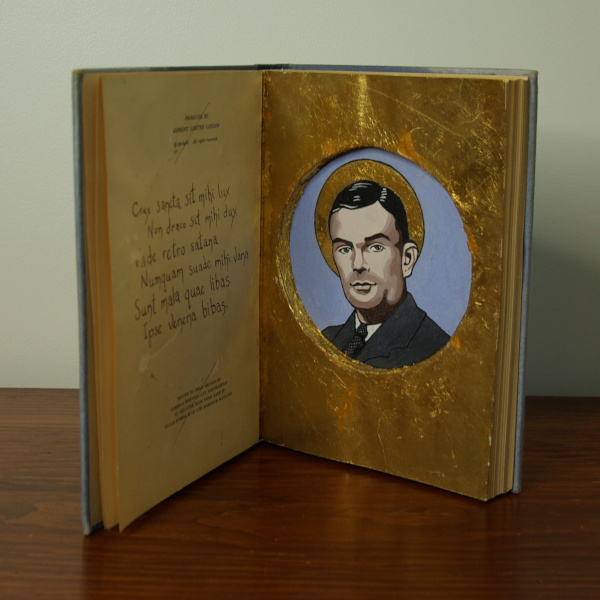
IT Repair Manual of Last Resort, approximately 2009, Egg Tempera on Book, 8 by 6 Inches
IT Repair Manual of Last Resort, approx. 2009, Egg Tempera on Book, 8×6 in.
Portrait of Saint Turing, 2010, Egg Tempera on Panel, 11 by 9 Inches
Portrait of Saint Turing, 2010, Egg Tempera on Panel, 11×9 in.
Looking For Satellites (Portrait of Saint Turing), 2023, Acrylic on Paper, 6 by 6 Inches
Looking For Satellites (Portrait of Saint Turing), 2023, Acrylic on Paper, 6×6 in.
Icon of Saint Turing, 2025, Acrylic on Wood, 9 by 11 Inches
Icon of Saint Turing, 2025, Acrylic on Wood, 9×11 in.
Saint Turing (Fortunate Sons 4), 2024, Mixed Media on Paper, 18 by 12 Inches
Saint Turing (Fortunate Sons #4), 2024, Mixed Media on Paper, 18×12 in.

I’m not sure when I first painted Alan Turing as a saint. It was probably the tail end of the 90’s, and it was probably on a floppy disk. Since then, I’ve done a number of versions, as well as icons for Hopper, Shannon, and other luminaries.

In 1950 Alan Turing’s paper “Computing Machinery and Intelligence” was published in Mind. A paper which contains remarkable insights into the possibility of machine intelligence. It asks questions which 75 years later, we are still struggling with.

“We can only see a short distance ahead, but we can see plenty there that needs to be done.”

— Alan Turing